Whether it’s a famous comedian like Adam Carolla, a sports persona like Colin Cowherd, or a weekly story told in sections like the podcasting sensation Serial, podcasts have found their way into the mainstream. As this new method of entertainment has taken off, hundreds have begun to create their own podcasts, many on their own with their own equipment. While few have taken off like those mentioned before, podcasting is still a way to get information out to small followings.
This has become apparent to many educators, and teachers and administrators have begun to use this medium in order to better educate their students. Some teachers may record lectures so that students can listen back and retain more of the information. Some may record supplemental information podcasts that dive more in depth into subjects being taught so students can listen at home or on the go. Music teachers, art teachers, coaches – whatever the application, a podcast is a way for educators to distribute information to students in a more far-reaching way than the classroom alone can provide.
Our download will give educators the basic information they need to record, edit and distribute podcasts that students will respond to. That means solid sound quality, playback ability across multiple devices and utilizing the right software to edit the podcast correctly. In this document you’ll learn about:
- Best practices for recording
- Recording devices
- Editing and mixing software
- EQ and volume
- Exporting audio files
- Hosting companies
- File sharing software
After reading our download you’ll be ready to go out and start your very own podcast. Before you know it, your students will be learning even when far away from the classroom.

Latest Resource
An Educator’s Guide to Podcasting at School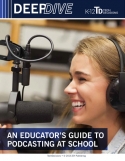 Podcasting has taken off as a means of entertainment, news and education in the past few years.
You need to be logged in to access this download.